01
Three hazard-related classes
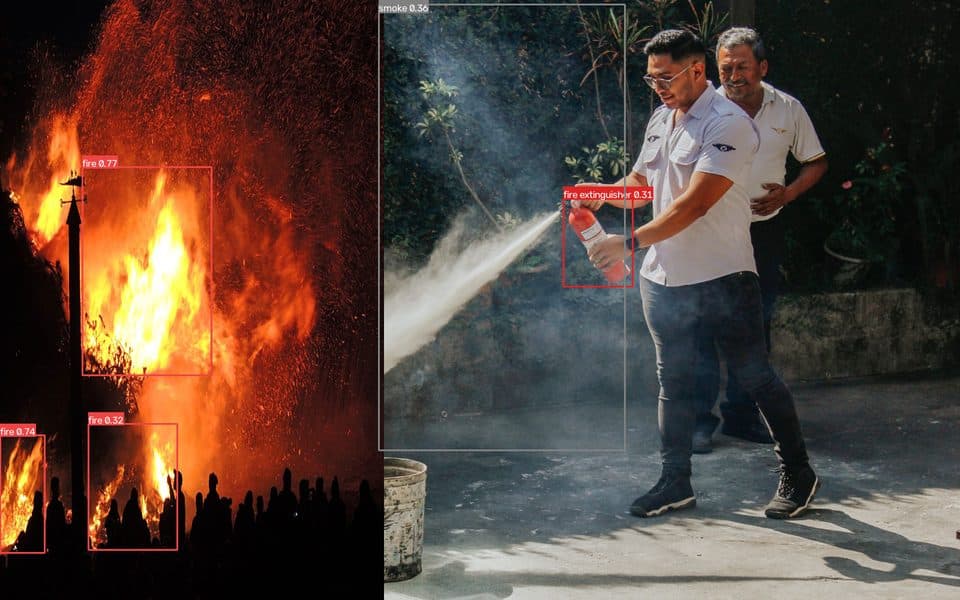
The release distinguishes fire, smoke, and extinguishers.
Class-aware handling can support different downstream rules, but each class needs local examples, hard negatives, and an explicit response policy.
A compact fire, smoke, and extinguisher detector built for edge evaluation.
Outdoor fire and smoke detection skill — public demo and edge-oriented ONNX packaging.
Evidence posture
Public artifact · Clear provenance · Stated limitations
~90% (protocol)
Reported accuracy
Reported for the published release; validate independently.
~9.8 MB
Artifact size
Reported for the published release; validate independently.
ONNX
Format
Reported for the published release; validate independently.
What this release is
Ember is an Innomium internal product and public technical demonstration focused on three hazard-related classes: fire, smoke, and fire extinguisher. Its public Space documents browser-local inference, a ~9.8 MB ONNX footprint, class-aware post-processing, and a stated 90% accuracy figure.
Why it matters
Visual hazard detection can add useful attention to a safety workflow, but the cost of both misses and false alerts is high. Fire appearance changes with distance, fuel, weather, lighting, camera exposure, reflections, haze, steam, and smoke color. Ember is therefore best understood as a concrete research artifact to evaluate—not a replacement for certified safety systems.
Technical anatomy
Each module below separates what is publicly observable from what still requires reproduction, local evaluation, and production engineering.
The release distinguishes fire, smoke, and extinguishers.
Class-aware handling can support different downstream rules, but each class needs local examples, hard negatives, and an explicit response policy.
The public demo describes per-class suppression, smoke merging, and confidence controls.
These techniques help shape noisy detections into more useful outputs. They remain tunable components whose behavior must be evaluated on representative scenes.
The demonstration runs the model in the browser without uploading frames.
Local execution is useful for privacy-conscious evaluation and edge feasibility. A production camera pipeline still needs hardware profiling, update control, telemetry, and recovery.
The public artifact reports a model size of approximately 9.8 MB.
That footprint creates deployment options, but file size alone does not establish frame rate, thermal stability, recall, or complete system reliability.
Evaluation interpretation
Read public figures as a reason to investigate—not a reason to skip acceptance testing.
The public release states 90% accuracy. A responsible evaluation should identify the split, class balance, thresholds, confusion patterns, and performance on a held-out set from the intended environment.
Steam, clouds, glare, orange lighting, welding, reflections, dust, and ordinary exhaust may resemble hazards. These cases should be represented deliberately.
Measure time-to-signal, repeated alerts, temporal confirmation, escalation, operator load, connectivity loss, and model health as part of the acceptance plan.
Application hypotheses
These are potential application patterns, not claims of completed client deployments. Each requires its own technical and operational evidence.
Explore an additional visual signal for warehouses, production areas, loading zones, or remote perimeters alongside established safety controls.
Investigate camera viewpoints and environmental conditions where visual cues may support earlier attention, subject to extensive local validation.
Evaluate whether camera-based presence checks can complement—never replace—formal inspection and compliance processes.
Responsible boundaries
Technical confidence grows when limitations are explicit and testable.
Ember must not be represented as a substitute for required detectors, alarms, inspections, or emergency procedures.
Visual appearance and camera conditions vary substantially. Local evidence, redundancy, and accountable human response remain essential.
Monitoring, escalation, maintenance, audit, incident review, and failure recovery are part of the product—not optional deployment details.
From artifact to adoption
The exact path depends on the release and intended use. The discipline remains the same: inspect, reproduce, evaluate, and only then integrate.
Use the public browser demo to understand the output classes and quickly collect obvious successes and failures.
Evaluate representative hazards and hard negatives under varied distance, lighting, weather, and camera quality.
Define temporal confirmation, redundancy, escalation, human review, monitoring, and the role of existing safety systems.
Run a bounded, observable pilot with safety leadership, documented acceptance criteria, and a clear stop condition.
Inspectable artifacts
Ember’s public Space is useful for inspecting the artifact and its browser-local execution. Any operational use must preserve required safety systems and undergo site-specific technical, legal, and safety review.
Evidence label
Innomium Ember is labeled as internal product. It is not presented as an approved client case study. Published metrics follow the release’s stated or Innomium protocols and require validation in the intended environment.
Request a consultation for reproduction, domain evaluation, adaptation, integration, or a production-readiness decision grounded in your data and operating constraints.
Built for accountable delivery
We begin with the operating constraint, agree on what success looks like, and build a delivery path your technical and business teams can review.
01
Scope, constraints, milestones, and decision owners before build work starts.
02
Evaluation plans, working artifacts, and reviewable technical decisions—not presentation-only progress.
03
Integration, observability, documentation, and an operating path for the teams who own the result.