Generic models in specific environments
A detector that performs well on a public dataset can fail under the camera angles, density, weather, distance, and lighting found in a real site.
Innomium designs computer-vision systems for the conditions that matter: difficult scenes, constrained hardware, false-alarm costs, privacy boundaries, and existing operational workflows. Public edge models give you evidence to inspect before we adapt the system to your environment.
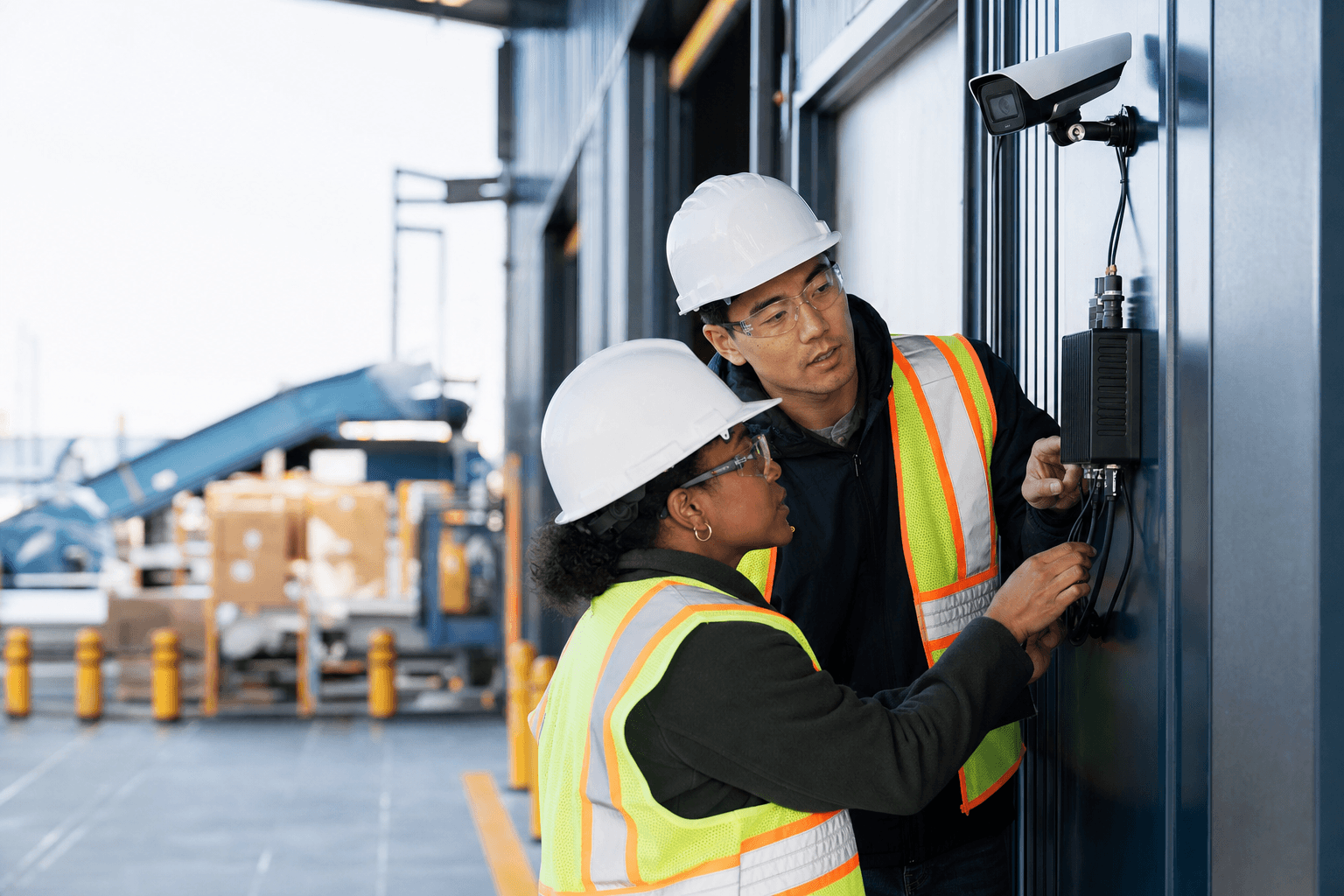
Performance is evaluated against held-out footage and failure conditions that reflect the deployment—not an unrelated public benchmark.
Edge, cloud, or hybrid inference is selected around latency, bandwidth, privacy, hardware, maintenance, and total operating cost.
Thresholds, review interfaces, escalation paths, and feedback loops are designed with the teams expected to respond.
Vision engineered for the scene
A general model benchmark cannot tell you how a system will perform at night, in weather, under occlusion, across a distant roadway, or inside a busy facility. We start with the scene and the cost of errors, then build the data, model, edge runtime, review workflow, and evaluation protocol around those realities.
A detector that performs well on a public dataset can fail under the camera angles, density, weather, distance, and lighting found in a real site.
Streaming every frame may violate latency, bandwidth, resilience, privacy, or cost constraints that become obvious only during deployment.
Even accurate detection creates little value when nobody owns review, escalation, feedback, maintenance, or model drift.
What we bring together
Every module is adapted to the engagement. The deliverables below describe the practical evidence and operating assets the work is designed to leave behind.
Evaluate camera placement, resolution, frame rate, environmental conditions, target scale, and the operational cost of misses and false alarms.
Design labeling guidance, scene-aware splits, adaptation experiments, and compact models suited to the target workload.
Package inference for constrained devices using appropriate runtimes and connect local decisions to cloud review, storage, or management when needed.
Connect detections to dashboards, incident workflows, APIs, and human review while capturing feedback for future evaluation.
Where this creates value
These are representative application patterns. The right opportunity is selected from your operating problem, data, risk, and ability to own the result.
Detect defined hazards, restricted-area events, occupancy conditions, or process exceptions with site-specific evaluation and human review.
Understand vehicle classes, traffic patterns, queue conditions, or site movement using models designed for roadway and yard perspectives.
Build early visual detection paths for outdoor environments while explicitly managing weather, haze, distance, and false-positive conditions.
Measure defined environmental or flow conditions with edge processing and data-minimization principles appropriate to the use case.
Two ways to engage
Choose a managed program when the result is defined, or a dedicated team when sustained specialist capacity matters. Both models include explicit ownership and review.
Organizations with a defined site, visual problem, and operational owner.
We own scene analysis, data and model work, deployment packaging, workflow integration, evaluation, and handover for a bounded deployment.
Teams building a multi-site, multi-model, or continuously evolving vision platform.
A persistent team works across datasets, models, edge packaging, evaluation, and platform integration as the deployment portfolio grows.
Delivery model
Work advances through evidence, working artifacts, and explicit decisions. The exact cadence changes; accountability does not.
Document cameras, environments, target events, operating response, and the real cost of false positives and misses.
Create representative data, labeling rules, scene splits, baselines, and acceptance thresholds before model investment expands.
Train or adapt the model, profile it on target hardware, and build the edge, cloud, or hybrid inference path.
Connect the system to operations, monitor failures, capture review feedback, and establish a controlled update process.
Representative engagement
An operator has existing outdoor cameras covering large areas with changing weather, distant objects, vegetation, and occasional haze. Earlier off-the-shelf trials produced too many false alerts.
The challenge
The problem requires more than a different model. The deployment needs scene-specific negatives, distance-aware evaluation, thresholds that reflect response cost, edge performance profiling, and a review path for ambiguous events.
A credible delivery path
Inventory representative cameras and build scene groups across light, weather, distance, and background conditions.
Establish a held-out evaluation protocol that includes difficult non-fire events.
Evaluate and adapt a compact model, then profile inference on the proposed edge target.
Connect detections to a review workflow and use reviewed events to drive later regression testing.
What the engagement is designed to leave behind
The operator receives evidence for a deployment decision, a tested runtime path, and a clear understanding of remaining limitations. This is a representative engagement scenario; published Ember artifacts are separate first-party research.
Proof you can inspect
Vision proof is first-party and publicly inspectable. Site performance requires a deployment-specific protocol and is never inferred from a general benchmark.
Connected ecosystem
Related expertise
Design, build, evaluate, and integrate production AI systems around the operating realities of your business.
Explore AI systemsResolve difficult model and system questions through scoped experiments, inspectable evidence, and explicit go-or-stop decisions.
Explore InfrastructureDesign and operate secure, observable delivery and runtime foundations for AI and software workloads.
ExploreOften yes. We first assess resolution, angle, frame rate, lighting, target size, access, and reliability to determine whether existing cameras can support the intended task.
Request a technical consultation about computer vision. Share the operating problem, constraints, timeline, and what a valuable first phase would need to prove.
Built for accountable delivery
We begin with the operating constraint, agree on what success looks like, and build a delivery path your technical and business teams can review.
01
Scope, constraints, milestones, and decision owners before build work starts.
02
Evaluation plans, working artifacts, and reviewable technical decisions—not presentation-only progress.
03
Integration, observability, documentation, and an operating path for the teams who own the result.