Skip to content
Internal ProductPublic research release

Innomium Sentinel

A compact person-detection release for testing dense-scene edge vision.

Compact person-detection skill for dense scenes — public ONNX package with a live browser demo.

Inspectable artifactProtocol-specific evidenceIndependent validation required
Innomium Sentinel public research release

Evidence posture

Public artifact · Clear provenance · Stated limitations

~92% (protocol)

Reported accuracy

Reported for the published release; validate independently.

19 MB

Artifact size

Reported for the published release; validate independently.

ONNX

Format

Reported for the published release; validate independently.

What this release is

Public evidence designed to be questioned.

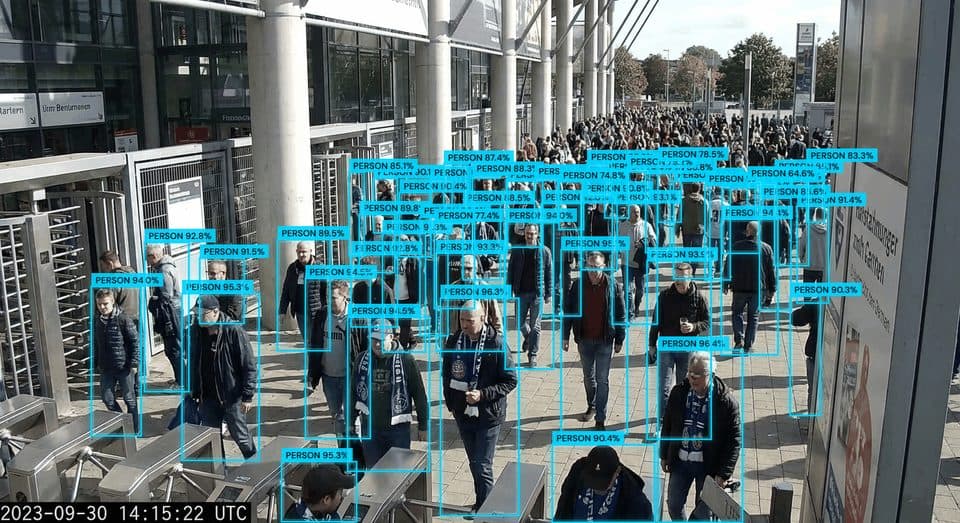
Sentinel is an Innomium internal product and public technical artifact—not a client case study. It packages a person detector as an ONNX model with a browser-accessible demonstration, giving teams a concrete place to investigate scene fit, model footprint, threshold behavior, and the work between detection and an operational workflow.

Why it matters

Person detection is widely available, yet dependable performance is intensely local. Camera height, crowd density, object scale, occlusion, compression, lighting, motion, and privacy policy determine whether a generic detector is useful. Sentinel is most valuable as an inspectable baseline: a model that can be challenged against the actual scenes and consequences of a proposed use case.

Technical anatomy

Inspect the layers behind the headline.

Each module below separates what is publicly observable from what still requires reproduction, local evaluation, and production engineering.

01

Detection focus

Single-purpose person detection keeps the evaluation surface understandable.

A narrower class definition can simplify analysis, but it does not remove scene variation. Acceptance should still segment results by crowd density, distance, visibility, and camera viewpoint.

02

Portable artifact

The published ONNX package is intended for practical runtime evaluation.

ONNX makes it possible to test CPU, edge, or browser-oriented paths without assuming the production device. Actual latency, memory, and compatibility must be measured on representative hardware.

03

Interactive evidence

The public demo makes qualitative inspection immediate.

A demo can expose obvious strengths and failure modes quickly. It cannot replace a held-out dataset, repeatable protocol, or privacy review for a real operating environment.

04

Workflow starting point

Detections can become inputs to occupancy, queue, or exception workflows.

A production system still needs temporal logic, zone rules, confidence policy, review, monitoring, and a documented response when the model is uncertain.

Evaluation interpretation

A metric is useful only when the protocol survives scrutiny.

Read public figures as a reason to investigate—not a reason to skip acceptance testing.

01

Read ~92% as a protocol snapshot.

The published figure reflects Innomium crowd evaluation splits. It should be treated as reported evidence for that setup, not a promise for a different camera estate or definition of correctness.

02

Inspect misses and false alerts separately.

A single average can conceal the cases that matter most. Break results down by scale, occlusion, density, lighting, and scene, then weight errors by their operational consequence.

03

Measure the complete runtime.

Model size is useful, but deployment decisions also require preprocessing, post-processing, frame rate, memory, warm-up, thermal behavior, and recovery testing.

Application hypotheses

Where this artifact may create leverage.

These are potential application patterns, not claims of completed client deployments. Each requires its own technical and operational evidence.

HYPOTHESIS 01

Occupancy and capacity signals

Evaluate aggregate presence or flow where the organization has a legitimate purpose and a privacy-conscious architecture.

HYPOTHESIS 02

Queue and congestion observation

Use detections as one input to a time-based operational signal rather than treating each box as a final conclusion.

HYPOTHESIS 03

Embedded product experiments

Test whether a compact person detector can fit the hardware, latency, and update model of a device or local application.

Responsible boundaries

Know what the release does not establish.

Technical confidence grows when limitations are explicit and testable.

Not identity recognition

Sentinel is presented as person detection, not face recognition, identity resolution, demographic inference, or behavior judgment.

Not a surveillance policy

Acceptable use, notice, minimization, access, retention, and review require explicit organizational and legal decisions.

Not validated for your site

A deployment program must establish local evidence and a rollback path before operational reliance.

From artifact to adoption

Earn confidence one gate at a time.

The exact path depends on the release and intended use. The discipline remains the same: inspect, reproduce, evaluate, and only then integrate.

01

Reproduce

Run the public artifact and confirm the expected model, inputs, outputs, and runtime in a controlled environment.

02

Challenge

Build a representative, permissioned scene set and investigate error patterns instead of tuning immediately.

03

Adapt

Improve data, thresholds, post-processing, or weights only where the baseline evidence identifies a material gap.

04

Pilot

Test the complete workflow with monitoring, human review, failure handling, and a defined acceptance decision.

Inspectable artifacts

Follow the evidence to its source.

Use the live demonstration for initial qualitative inspection. Before commercial or production use, review the applicable model card, license, dependencies, data handling, and local acceptance evidence.

Evidence label

Innomium Sentinel is labeled as internal product. It is not presented as an approved client case study. Published metrics follow the release’s stated or Innomium protocols and require validation in the intended environment.

Browse all releases →

Evaluate Innomium Sentinel against the environment that matters.

Request a consultation for reproduction, domain evaluation, adaptation, integration, or a production-readiness decision grounded in your data and operating constraints.

Built for accountable delivery

Clear scope. Technical evidence. A team that can ship.

We begin with the operating constraint, agree on what success looks like, and build a delivery path your technical and business teams can review.

01

Defined outcomes

Scope, constraints, milestones, and decision owners before build work starts.

02

Evidence at every stage

Evaluation plans, working artifacts, and reviewable technical decisions—not presentation-only progress.

03

Production handover

Integration, observability, documentation, and an operating path for the teams who own the result.